Smarter irrigation starts with the basics – lessons from Mt Gambier event
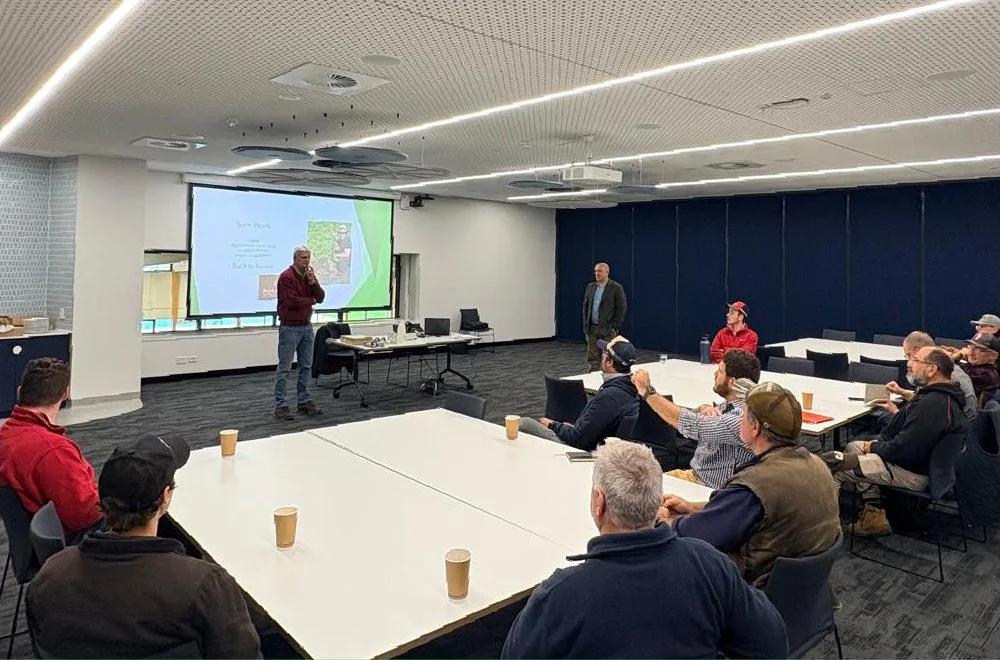
Growers and industry members gathered at the Mt Gambier workshop. Image: Tom Jefferies
Water is a key constraint facing potato growers in the Limestone Coast (SA), but making the most of every available drop is not only about installing the latest irrigation technology.
At a recent PotatoLink event in the region, growers and advisers explored the factors that underpin good irrigation management, including soil health and water quality, infrastructure maintenance, soil variability, and the potential role of Variable Rate Irrigation (VRI).
The key message was a very practical one: Before investing in more sophisticated technology, it pays to understand what is happening in the soil, know how much water the irrigation system can actually deliver, and make sure the hardware is working as it should.
Look at the soil
For growers in this region, water scarcity is not the only challenge; soil variability can make irrigation management particularly challenging. Differences can occur within the same paddock, a problem compounded for growers leasing land with potentially limited knowledge of a site’s previous management, soil condition, or water history.
Sam Work from the Limestone Coast Water Alliance encouraged growers to start by looking at the fundamentals of soil health, including its physical, biological and chemical properties.
Physical observations like compaction can be relatively simple, he states. A penetrometer can help identify compaction, but so too can observations in the weeds present. Biological testing can provide further information about indicators such as disease resistance, drought tolerance, residue breakdown and nutrient cycling.
Carbon is another important part of the picture. As well as contributing to soil biology, organic carbon helps the soil hold water and nutrients.
Knowledge of the soil chemistry, particularly in the high-pH, high-calcium soils common across the region, is also very helpful. Simple pH testing can provide a useful first indication of soil conditions, while comprehensive soil testing gives a clearer picture of nutrient levels and availability.
In high-pH, high-calcium soils, total phosphorus can be high even when little is available to the plant, so a DGT-P test can help show how much phosphorus the crop can actually access.
Read more about Improving phosphorus uptake efficiency of potatoes in this factsheet.
Water quality and the system itself
The quality of the water entering the irrigation system also needs to be considered. Factors such as total dissolved solids, salinity, pH, hardness, and chlorine can influence irrigation and crop performance.
As with the soil, testing water quality gives growers information they can use to make better decisions about irrigation, fertiliser programs, and soil management, rather than treating each issue in isolation.
The next step is making sure the irrigation system itself is doing the job it is supposed to do.
Sam highlighted the importance of comparing system capacity with crop water demand, using factors such as evapotranspiration and crop growth stage. Knowing the theoretical capacity of a system is one thing; knowing what it is actually delivering in the paddock is another.
A basic irrigation check should include:
Sprinkler package condition and age (the 10 year rule)
Pressure at the end of the pivot and pressure regulation
Engine speed
Main pipe condition
Condition of gearboxes, tyres, joints and other running gear
Cooling systems and control panels
Site irrigation history
An example presented on the day showed how poor pressure and an ageing sprinkler package were contributing to poor uniformity, lower production and higher running costs (left image). Addressing those basic system issues improved pressure and uniformity while reducing operating costs (right image).
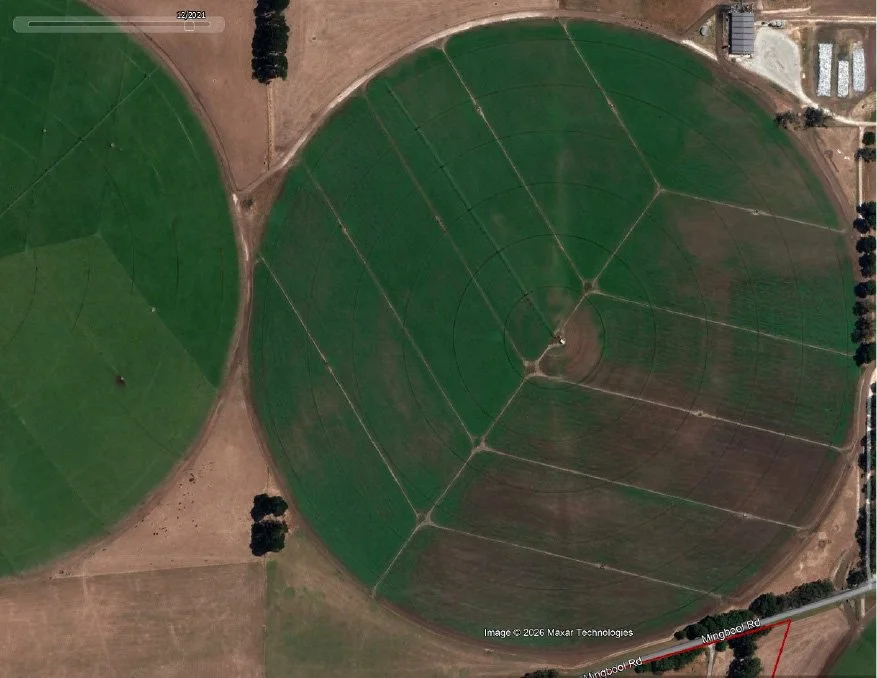
Example site before VRI implementation. Image: Google, Maxar Technologies
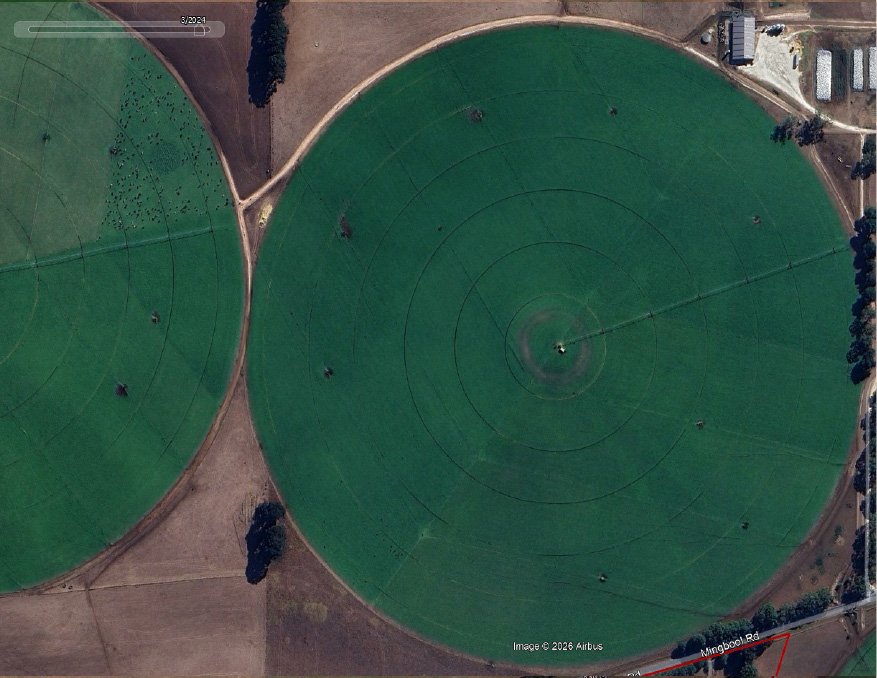
Example site post VRI implementation. Image: Google, Airbus
Variable Rate Irrigation (VRI)
Variable Rate Irrigation (VRI) can be a useful tool where there is significant variation across a paddock, but it is not necessarily the right answer for every farm.
Tom Jefferies from Thomas Elder Sustainable Agriculture outlined a series of questions each grower should consider before opting for VRI.
Firstly, is there enough soil or crop variability to justify treating different areas differently? Can variability be addressed through improving soil drainage or practices like clay spreading and delving? Is water, energy, or irrigation performance limiting profitability? Is the water quality suitable? Is there reliable data available to define and manage irrigation zones? And will the expected benefits provide a worthwhile return on investment?
There are also questions about the people and business behind the technology.
Does the business need to see a return within one or two years? Does the farm team have the skills and confidence to interpret the data? Is there access to technical support? And is there enough time to actively manage the system?
These questions are important because VRI is not a set-and-forget technology. It relies on good information and ongoing management.
A practical approach starts with mapping soil variability using tools such as EM38, gamma mapping or elevation data. From there, growers can develop irrigation zones, install soil moisture probes in representative areas and calculate crop water requirements using evapotranspiration and crop coefficients.
Prescription maps can then be developed, with irrigation adjusted according to conditions. Soil moisture, rainfall and crop growth provide feedback, allowing the system to be refined over time.
The final step is arguably the most important – evaluating whether it worked. Yield, quality, water use and profitability should be compared from season to season, with the results used to refine irrigation zones and prescriptions.
Learn more about VRI, precision agriculture, and managing irrigation in this webinar and article.
An example
A case study shared by Tom illustrated how VRI can be combined with EM38 mapping, soil moisture probes and drone imagery to better understand variability within a potato crop.
The Mallee-based trial is still underway, with further data to be collected in early 2027, but the approach demonstrates the value of combining different data sources rather than relying on a single technology.
That broader approach is becoming increasingly relevant as more tools become available to growers. Soil moisture sensors, satellite imagery, drones and other digital tools can all provide useful information, but the technology is most valuable when it answers a specific management question.
PotatoLink looks forward to following and reporting on this trial, when possible, throughout 2027.
