
WPC Special: Exploring the Potential of 2E-Hexenal in Potato Storage Management
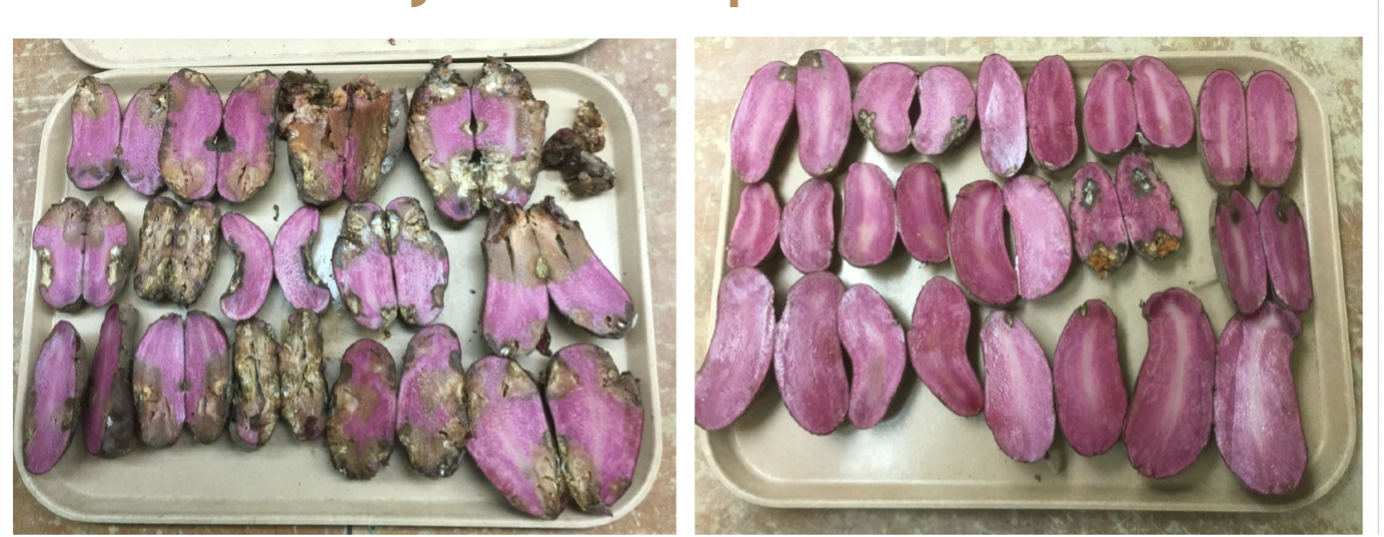
Tubers cv. Vermillion that were inoculated with fusarium dry rot, then left untreated (left) or fumigated with 8mL/ton 2E-Hexanal (right), following 3 weeks storage. Source: presentation by P. Wharton
How do you control diseases in stored potatoes when fungicide options are limited? Associate Professor Phillip Wharton from the University of Idaho has been exploring alternative methods to control storage diseases for over ten years, with some highly promising results.
The potato industry is big in Idaho. The state produces approximately 7 million tons of potatoes annually, valued at $1 billion. However, 0.5 million tonnes of the potatoes placed in storage are lost due to disease and shrinkage, translating to a financial loss of around $73 million each year. This substantial loss underscores the need for effective storage management solutions.
Dr Wharton and his team have been examining the potential of plantderived volatile organic compounds (VOCs). VOCs are usually produced by plants in response to physical damage or insect feeding. These compounds contribute to plant defences, as well as signalling danger to other plants. Some are already well known for their antimicrobial properties. However, the rapid diffusion of these compounds in air has restricted practical application.
Among the various plant-derived VOCs, 2E-Hexenal has emerged as a highly effective agent when tested in vitro against potato pathogens. 2E-Hexenal is part of the green leaf volatiles, contributing to the characteristic smell of freshly cut grass and leaves, and possesses strong antimicrobial properties.