
Eyes on the world: Polymer coated urea in ‘Russet
Getting fertiliser into the soil when and where it is needed is a constant challenge. Too little and growth is impaired. Too much and plants develop more canopy than tubers, with the excess N polluting groundwater and/or volatilising into the air.
Controlled or slow-release sources of N can potentially improve the synchronisation between plant development and availability of nutrients in the soil. Polymer coated urea (PCU) consists of granulated urea with a thin polymer coating. The rate of release depends on soil temperature together with coating thickness.
There have been many studies comparing PCU with traditional N sources for potato production. In all cases yield was similar or increased. However, previous studies were done in relatively high rainfall areas with good soils. This study was conducted in the Pacific Northwest USA, a semiarid climate with relatively sandy soils - this makes it more analogous to the conditions in some Australian growing areas.
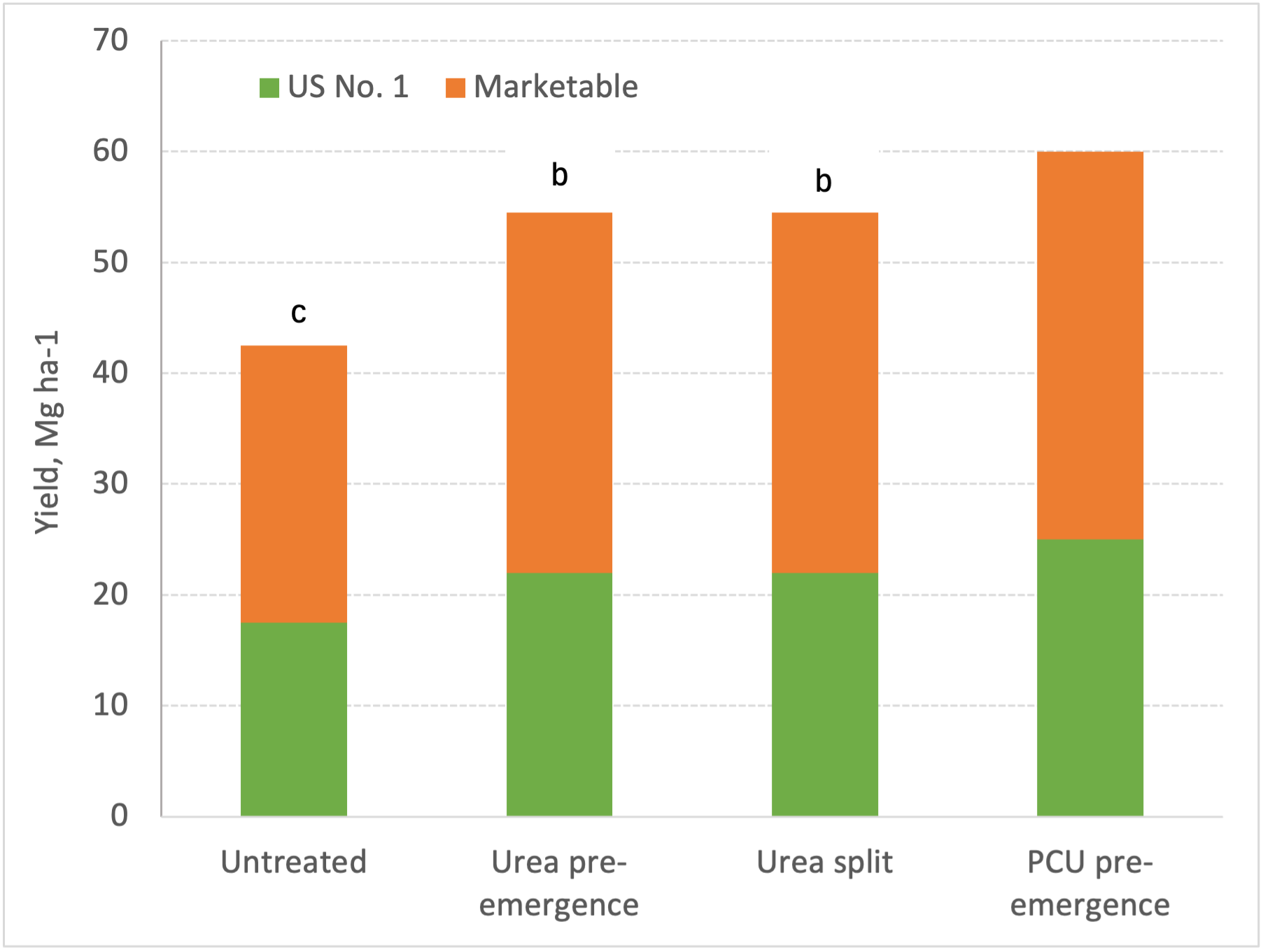
Figure 1. Yield of US No. 1 and marketable Russet Burbank potatoes, averaged across three locations and four N rates for different N sources (urea applied pre-emergence, urea split over 4 applications and polymer coated urea (PCU)) relative to an untreated control. Letters indicate values that are significantly different (p<0.05). Derived from Taysom et al, 2023.